
Printable Mazes
Generate a brand-new maze every time — from simple 8 × 8 mazes for young children to challenging 40 × 40 puzzles for adults. Choose the size and style, print it, and print the answer key with the solution path marked.
- Free to use
- No sign-up
- Runs in your browser
Generate a printable maze
Maze Activity Book (100 Mazes)
A ready-to-print book of 100 mazes in five difficulty levels, with answer keys, plus maze colouring pages.
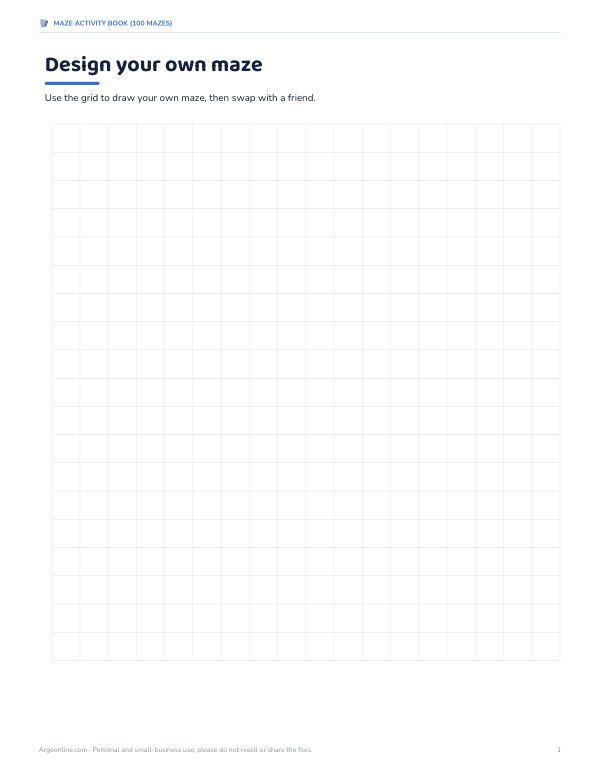
- Maze drawing & activity pages (PDF, DOCX)
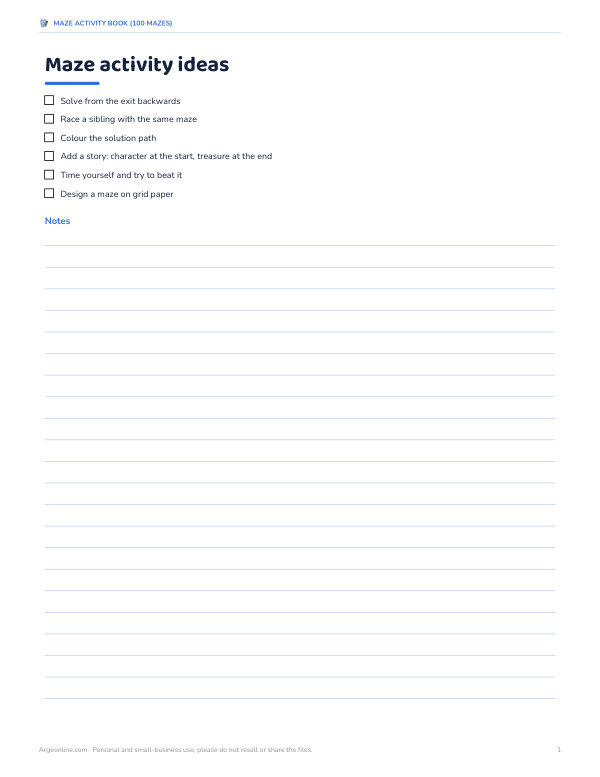
- Activity ideas (PDF, DOCX)
Formats: PDF, DOCX. Instant download after payment (link valid 72 hours, up to 5 downloads). AI-assisted: the templates were drafted with AI help and reviewed and laid out before publishing.
$4.00 USD, one-time
- Instant download
- 7-day refund
- Secure checkout by Stripe
7-day money-back guarantee. Full refund within 7 days of purchase, even after you download.
Full refund within 7 days — see the refund policy and license.
Free printables
Single sheets you can print right now, no sign-up. The full pack adds every sheet in one download plus the editable files.
How the maze generator works
Each maze is created fresh in your browser using a depth-first search, the “recursive backtracker” algorithm. It starts in one corner, carves a passage to a random unvisited neighbouring cell, and keeps going until it reaches a dead end; then it backs up until it finds a cell with unvisited neighbours and continues. The result is a “perfect” maze: every cell is reachable, and there is exactly one path between any two points, so the maze has a single correct solution. The generator then solves it with a breadth-first search to draw the answer key.
Choosing a difficulty
| Difficulty | Grid | Typical solver | Time to solve |
|---|---|---|---|
| Very easy | 8 × 8 | Ages 3–5 | Under a minute |
| Easy | 12 × 12 | Ages 5–7 | 1–3 minutes |
| Medium | 18 × 18 | Ages 7–10 | 3–6 minutes |
| Hard | 26 × 26 | Ages 10+ | 5–15 minutes |
| Very hard | 36 × 36 | Teens and adults | 10–30 minutes |
Larger grids have longer solution paths and more dead ends. The four-per-page layout uses smaller grids so each maze stays readable on a quarter page.
Why mazes are good for children
- Planning and problem solving: children learn to look ahead, test a route and back up when they hit a dead end.
- Fine motor control: drawing a line through the passages without touching walls practises pencil control.
- Visual perception: tracking paths across the page builds visual scanning skills useful for reading.
- Persistence: finishing a harder maze is a small, satisfying achievement.
- Screen-free fun: ideal for travel, waiting rooms, restaurants and quiet time.
Tips for solving mazes
- Start from the exit and work backwards — it is often easier.
- Look for long corridors and follow them first.
- The wall-follower rule works on perfect mazes like these: keep one hand on the same wall and you will always reach the exit, though not by the shortest route.
- Lightly shade dead ends to rule them out.
- Use a pencil so wrong turns can be erased.
Ideas for using printable mazes
- Party activity packs and restaurant table mats.
- Classroom early-finisher work and brain breaks.
- Timed challenges between siblings or teams — print the same maze twice.
- Travel packs with a clipboard and crayons.
- Puzzle pages for newsletters and activity books (the mazes you generate are yours to use).
- Occupational therapy and pencil-control practice with very easy mazes.
Worked example
Choose “Medium (18 × 18)”, two per page, and the title “Can you find the way out?”. The page shows two different mazes, each about 4.3 inches square, with IN at the top-left and OUT at the bottom-right. Print a second copy with “Print answer key”: the solution path appears as a red line through each maze. Press “New maze” for a completely different pair.
A short history of mazes and labyrinths
People have built and drawn mazes for thousands of years. The labyrinth of Greek myth, home of the Minotaur, gave its name to a single winding path; medieval churches such as Chartres Cathedral in France laid unicursal labyrinths into their floors for walking meditation. Hedge mazes became fashionable in European gardens from the sixteenth and seventeenth centuries — the maze at Hampton Court Palace in England, planted around 1700, is still visited today. Paper mazes and puzzle books followed, and computer scientists later formalised maze generation and solving as classic problems in graph theory, which is exactly how this generator builds and solves each puzzle.
Mazes for learning and therapy
Teachers and occupational therapists use mazes deliberately. Very easy mazes with wide corridors help young children practise holding a pencil and controlling a line, and tracing with a finger first builds confidence. Mazes also support visual-spatial reasoning and planning, skills linked to mathematics and reading. For children who find writing tiring, a maze is a short, motivating task with a clear finish. Start with the easiest size, praise completion rather than speed, and increase difficulty gradually as confidence grows.
Printing tips
Print at 100% scale on plain paper. Thicker walls (the classic style on small grids) are easiest for young children; the rounded style looks softer and works well for colouring. Mazes are vector graphics, so they print crisply at any size — choose “Save as PDF” in the print dialog to keep a set, or print on A4 using “Fit to page”.
Making mazes more fun
Turn a maze into a story: draw a character at the entrance and a treasure at the exit, or add small pictures in the corridors to collect on the way. Colour the finished path and frame it. For older children, challenge them to find the solution without lifting the pencil, or set a timer. Generating a fresh maze each time means the same challenge never repeats.
Frequently asked questions
Are the mazes different every time?
Yes. Each maze is randomly generated in your browser when you press “New maze”.
Does every maze have a solution?
Yes. The algorithm produces perfect mazes with exactly one path from entrance to exit.
Can I print the answer?
Yes, “Print answer key” prints the same mazes with the solution path in red.
What age are these mazes for?
From about age 3 (very easy) to adults (very hard).
Can I use the mazes in a newsletter or class packet?
Yes, mazes you generate here are free to use.
Why do the mazes disappear when I refresh?
They are generated on the page and not stored. Print or save as PDF to keep them.
What is a perfect maze?
A maze with no loops and no unreachable areas, so there is exactly one route between any two points, including the entrance and exit.